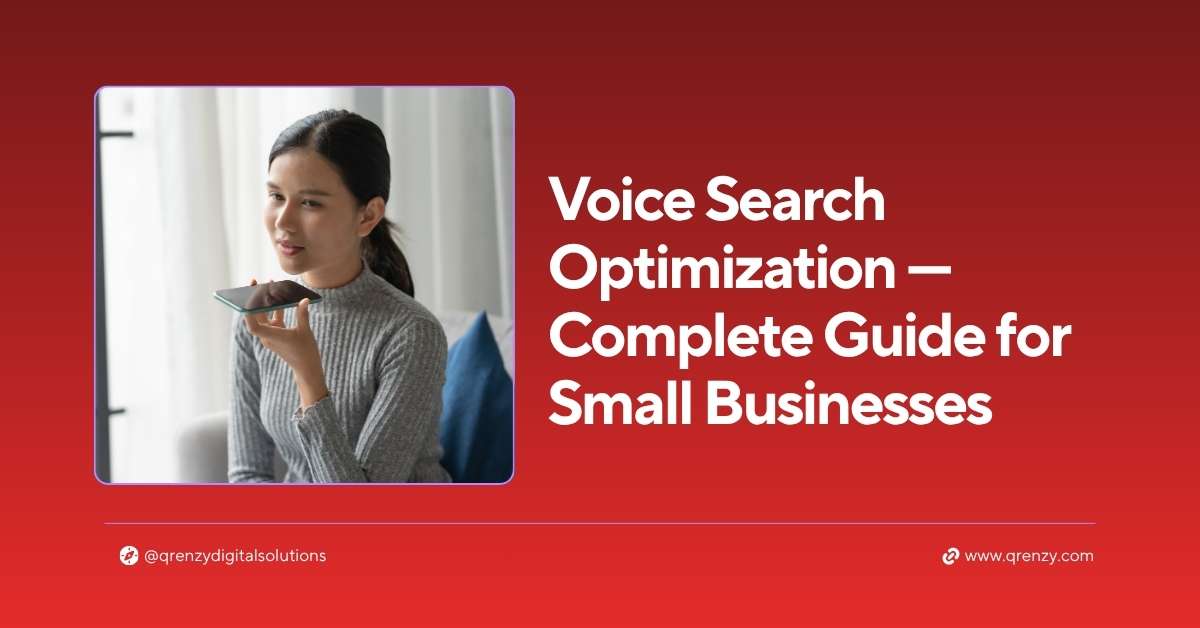
Voice search optimization is no longer a future trend — it’s happening right now, and most small businesses are completely unprepared for it.
Think about how you search on your phone. Two years ago you typed. Today you ask. “Hey Google, find a digital marketing agency near me.” “Siri, best restaurant open now in Thrissur.” “Alexa, who does SEO in Muscat?”
The numbers confirm this shift. There are currently 8.4 billion voice-enabled devices in use worldwide — more devices than people on earth. Over 50% of searches on mobile are now voice-based. And critically, 76% of all voice searches have local intent — meaning people are using voice to find businesses exactly like yours.
Here’s the problem: only 4% of businesses are genuinely optimized for voice search. That gap is your opportunity.
Why Voice Search Optimization Is Different From Regular SEO
Before diving into tactics, it’s important to understand why voice search optimization requires a different approach from traditional SEO.
When someone types a search, they use short, fragmented keywords: “SEO agency Thrissur”
When someone speaks, they use natural, conversational language: “Which is the best SEO agency in Thrissur for small businesses?”
Voice queries average 29 words — far longer than typed searches. They’re questions, not keywords. They’re conversational, not transactional. And they expect a single, direct answer — not a list of ten blue links.
This means your content needs to think differently. Instead of targeting keywords, you need to target questions. Instead of ranking on page one, you need to become the answer.
How Voice Search Works — and Where Your Answer Comes From
Understanding where voice assistants pull their answers helps you optimize strategically.
Google Assistant and Siri pull the majority of their voice answers from:
- Featured snippets (position zero) — over 50% of voice results come from here
- Google Business Profile — for local queries like “near me” searches
- Top 3 organic search results — most voice results come from pages already ranking in the top 3
- People Also Ask sections
Amazon Alexa pulls primarily from Bing search results and its own Alexa Skills ecosystem.
Practical implication: If your website already ranks in the top 3 on Google for your main keywords, you’re already a candidate for voice search results. Voice search optimization then becomes about formatting your content so voice assistants can extract and read your answer clearly.
Step 1 — Target Conversational, Question-Based Keywords
The foundation of voice search optimization is rethinking your keyword strategy around how people actually speak.
Traditional keyword: SEO services Kerala Voice search keyword: Which SEO agency is best for small businesses in Kerala?
Traditional keyword: best restaurant Thrissur Voice search keyword: What is the best restaurant open now in Thrissur?
How to find voice search keywords for your business:
Start with the five W’s and one H — Who, What, Where, When, Why, How. Every question starting with these words is a potential voice search query.
Examples for a digital marketing agency:
- “How much does digital marketing cost for a small business?”
- “What is the best way to get more customers online?”
- “Where can I find a good SEO agency near me?”
- “Why is my business not showing on Google Maps?”
- “How long does SEO take to work?”
Each of these should have a dedicated answer on your website — either as a standalone blog post, an FAQ section, or a service page subheading.
Step 2 — Win Featured Snippets
Over 50% of voice search results are pulled directly from Google’s featured snippet — the answer box that appears above all search results.
Winning the featured snippet for your target questions is the single most impactful voice search optimization strategy available.
Learn more about how Google Search works and how featured snippets are selected.
How to structure content for featured snippets:
Use a clear question as a heading followed immediately by a direct 40–60 word answer:
H2: How Long Does SEO Take for Small Businesses? Most small businesses see measurable improvements in Google rankings within 60–90 days of starting SEO. Significant organic traffic growth typically happens between months 3–6. Local SEO results, particularly on Google Maps, can appear faster — sometimes within 30 days of optimizing a Google Business Profile.
This format — question heading, direct paragraph answer — is exactly what Google extracts for featured snippets and reads aloud in voice search responses.
Other featured snippet formats that work:
- Numbered step lists (for “how to” queries)
- Bullet point lists (for “what are” queries)
- Comparison tables (for “vs” queries)
- Definition paragraphs (for “what is” queries)
Step 3 — Optimize Your Google Business Profile for Voice
For local voice searches — “near me”, “open now”, “best [service] in [city]” — Google Business Profile is the primary source voice assistants use to generate answers.
When someone asks “Hey Google, find a digital marketing agency near me” — Google pulls the answer from local GBP listings, not your website.
GBP optimization specifically for voice search:
- Business name — matches exactly what people say when searching for you
- Business description — written in natural, conversational language
- Services — every service listed with full descriptions
- Business hours — 100% accurate including holidays
- Q&A section — pre-load with questions people ask by voice
- Reviews — voice assistants read star ratings and review snippets aloud
The Q&A section is particularly powerful for voice search optimization. Add questions exactly as someone would speak them:
“Do you offer free consultations?” “Are you open on Saturdays?” “Do you serve businesses in Kochi?”
Each answer becomes a candidate for a voice search response. Read our complete Google Business Profile optimization guide for a full setup walkthrough.
Step 4 — Create a Dedicated FAQ Page
An FAQ page is the highest-ROI page on your website for voice search optimization. Every question and answer pair is a potential voice search result.
Structure your FAQ page correctly:
Each question should be an H2 or H3 heading — exactly as someone would ask it by voice. Each answer should be 40–60 words — concise, direct and complete.
Example FAQ entries for a digital marketing agency:
What does a digital marketing agency do? A digital marketing agency helps businesses grow their online presence through SEO, social media marketing, Google Ads, web design and content creation. The goal is to attract more customers online, generate leads and increase revenue through digital channels.
How much does digital marketing cost in India? Digital marketing services in India typically range from ₹10,000 to ₹50,000 per month depending on the services included. SEO packages start from around ₹8,000/month, while comprehensive campaigns including ads management and content cost more.
Is digital marketing worth it for small businesses? Yes — digital marketing delivers measurable ROI for small businesses. Local SEO and Google Business Profile optimization in particular can generate significant enquiries at very low cost compared to traditional advertising.
Each of these answers is formatted perfectly for a voice assistant to read aloud as a complete, satisfying response.
Step 5 — Optimize for Mobile Speed and Local SEO
Voice search is almost entirely mobile — 72% of voice searches happen on smartphones. This makes mobile page speed a critical factor in voice search optimization.
Mobile speed checklist:
- PageSpeed score above 90 on mobile
- Images compressed and served in WebP format
- No render-blocking scripts
- Core Web Vitals all passing
Beyond speed, traditional local SEO signals directly feed voice search rankings:
- NAP consistency — Name, Address, Phone identical across all directories
- Local citations — JustDial, Sulekha, IndiaMart, Yellow Pages
- Location pages — dedicated pages for each city you serve
- LocalBusiness schema — structured data telling Google your exact location and services
Voice search for local businesses is essentially local SEO done well. If your local SEO is strong, voice search rankings follow naturally.
Step 6 — Use Conversational Language Throughout Your Website
Read your homepage out loud. Does it sound like how a real person talks? Or does it sound like marketing copy?
Voice search optimization rewards websites that write the way people speak. Natural, conversational language is easier for AI systems to extract, understand and read aloud.
Instead of: “Qrenzy Digital Solutions provides comprehensive integrated digital marketing solutions leveraging cutting-edge technologies…”
Write: “Qrenzy helps small businesses get found on Google, grow on social media and generate more leads — without wasting budget on things that don’t work.”
The second version sounds natural spoken aloud. The first doesn’t. Voice assistants prefer the second.
Apply this principle across your homepage, service pages, about page and blog posts. Write for ears, not just eyes.
Step 7 — Add Structured Data Schema to Every Page
Schema markup is code that tells search engines exactly what your content means — making it significantly easier for voice assistants to extract accurate answers.
Schema types that directly support voice search optimization:
| Schema Type | What It Does |
|---|---|
| FAQPage | Marks up Q&A content for direct voice extraction |
| LocalBusiness | Tells voice assistants your location, hours and services |
| HowTo | Marks step-by-step instructions for “how to” queries |
| Speakable | Specifically tells Google which sections are suitable to be read aloud |
The Speakable schema is the most direct voice search optimization tool available — it literally flags your content for voice readout. Add it to your most important answer-style content.
If you’re using Yoast SEO on WordPress, FAQ Page and LocalBusiness schema can be enabled without touching code.
Voice Search Optimization Checklist
Here’s your complete action plan:
- ✅ Rewrite your FAQ page with natural, spoken questions as headings
- ✅ Add a 40–60 word direct answer below each FAQ question
- ✅ Optimize Google Business Profile — especially Q&A and services sections
- ✅ Add FAQPage and LocalBusiness schema to key pages
- ✅ Check mobile PageSpeed score — aim for 90+
- ✅ Audit NAP consistency across all directories
- ✅ Add conversational language throughout homepage and service pages
- ✅ Target featured snippets for your top 5 “how to” and “what is” questions
FAQs — Voice Search Optimization
Is voice search important for businesses in India? Absolutely. India has one of the fastest-growing voice search user bases globally, driven by smartphone adoption and the naturalness of speaking versus typing in regional languages. Voice search optimization is particularly impactful for local businesses serving Indian cities and Gulf markets.
Does voice search optimization affect regular Google rankings? Yes — positively. Most voice search optimization tactics (featured snippets, local SEO, mobile speed, structured data) also directly improve traditional Google rankings. Optimizing for voice search makes your entire SEO strategy stronger.
How do I know if my business is appearing in voice search results? Manually test by asking Google Assistant, Siri or Alexa questions your customers would ask about your business. Also check if your content appears in Google’s featured snippet or People Also Ask sections — these are the primary sources for voice answers.
Does my website need to be fast for voice search? Yes — page speed is a confirmed ranking factor for both traditional and voice search. Since voice is predominantly mobile, your mobile PageSpeed score is especially important. Start with a free SEO audit to check your current speed and technical health.
What’s the fastest way to start getting voice search traffic? Optimize your Google Business Profile completely and add a well-structured FAQ page to your website. These two actions target the most common voice search scenarios — local queries and direct questions — and can show results within weeks. Learn how getting found on ChatGPT and Google AI connects to voice search optimization for a complete visibility strategy.
Start Your Voice Search Optimization Today
Voice search optimization is one of the clearest competitive advantages available to small businesses right now. Only 4% of businesses have done it properly — which means 96% of your competitors haven’t.
The businesses that act now will dominate voice results for years. Start with your FAQ page, your Google Business Profile and your mobile speed — those three alone will put you ahead of most competitors.
Want expert help? Our free SEO audit reviews your current voice search readiness alongside your full SEO health. 🚀

Leave a Comment