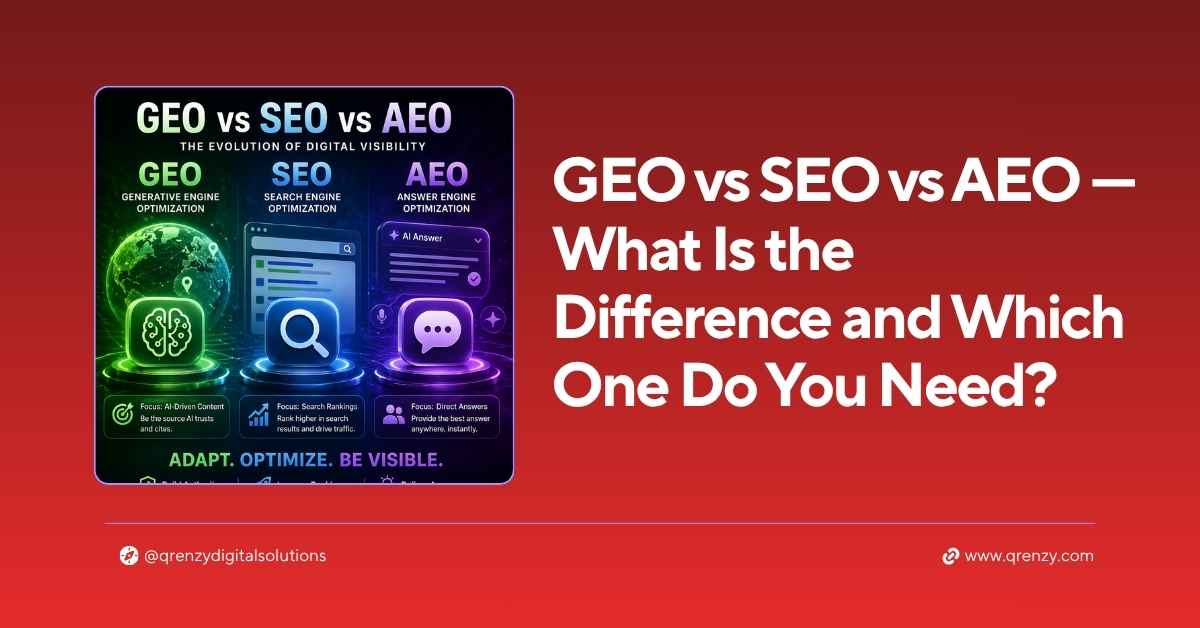
Every week, someone asks me the same question about GEO vs SEO vs AEO: are these just new names for the same thing, or genuinely different strategies?
“Sajeesh, I keep hearing about GEO and AEO. Are these just new names for SEO? Do I need all three? Which one should I focus on first?”
It is a fair question. Furthermore, the confusion is understandable — these three terms get used interchangeably all the time, even by people who should know better. However, GEO, SEO and AEO are genuinely different strategies, targeting different platforms, using different tactics and delivering different types of visibility.
In this guide, I will explain exactly what each one does, how they differ, how they overlap and — most importantly — which one your business in Kerala, Oman or the Gulf should prioritize right now. Additionally, I will share real examples and a practical checklist you can act on immediately.
The Quick Answer — GEO vs SEO vs AEO in One Line Each
Before diving deep, here is a plain-language summary of each:
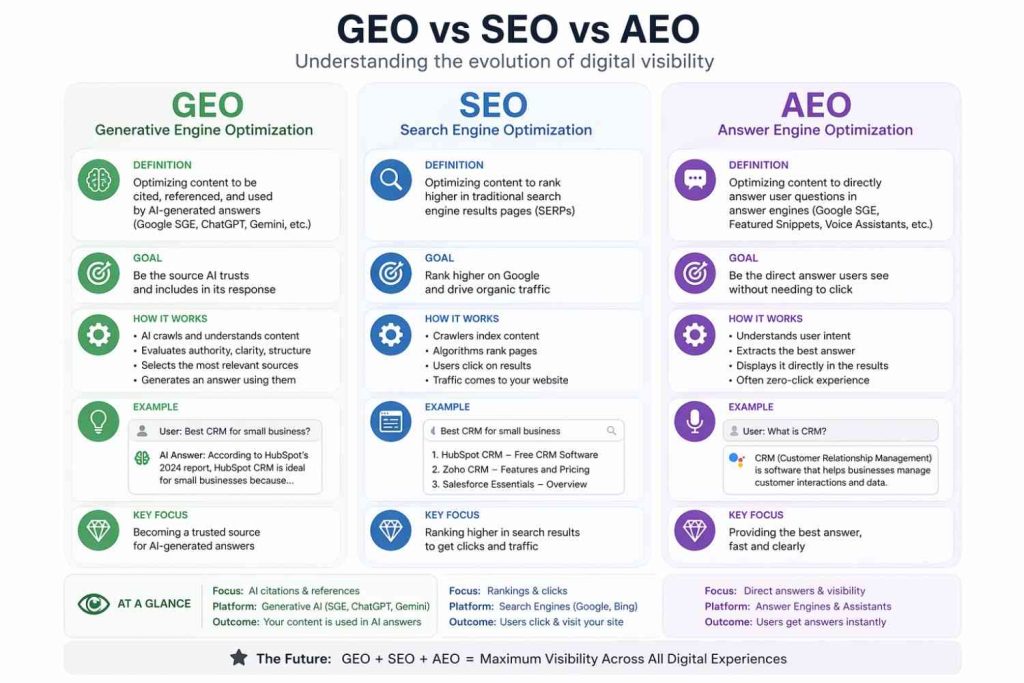
SEO (Search Engine Optimization): Getting your website to rank in Google’s traditional blue-link search results when people type keywords.
AEO (Answer Engine Optimization): Getting your content featured as a direct answer in Google’s featured snippets, People Also Ask boxes, voice search results and AI Overviews.
GEO (Generative Engine Optimization): Getting your brand cited, recommended and mentioned inside AI-generated responses from ChatGPT, Perplexity, Gemini and Bing Copilot.
Think of it this way — SEO gets you on the shelf. AEO gets you in the display case. GEO gets you personally recommended by the shop assistant. Understanding the GEO vs SEO vs AEO difference is the first step to building a complete AI-era digital marketing strategy.
The Full Comparison — GEO vs SEO vs AEO
Here is a detailed side-by-side breakdown:
| Factor | SEO | AEO | GEO |
|---|---|---|---|
| Primary goal | Rank in Google blue links | Feature in direct answer formats | Be cited in AI-generated responses |
| Where it shows up | Google, Bing search results | Featured snippets, PAA boxes, AI Overviews, voice search | ChatGPT, Perplexity, Gemini, Copilot responses |
| How users find you | Click on your link | Read the answer (often zero-click) | See your brand cited in an AI answer |
| Key ranking signals | Backlinks, technical SEO, content quality | FAQ schema, question-format headings, structured data | E-E-A-T, brand authority, entity consistency, third-party mentions |
| Content format | Keyword-rich long-form content | Self-contained Q&A blocks, definition-first structure | Authoritative, statistically dense, entity-based content |
| Results timeline | 3–6 months typically | 4–8 weeks for initial wins | 3–6 months for consistent citation |
| Traffic type | Click-based organic traffic | Mixed — some clicks, mostly zero-click visibility | AI referral traffic + brand awareness |
| Measurement | Rankings, organic traffic, CTR | Featured snippet presence, GSC impressions | AI citation frequency, branded search growth, AI referral traffic |
| Tools | Ahrefs, Semrush, Google Search Console | Same as SEO + schema validators | SEOmator GEO audit, manual AI citation tracking, GA4 AI referrals |
How GEO vs SEO vs AEO Relate to Each Other
SEO Is the Foundation
SEO is not going anywhere. In fact, strong SEO is the prerequisite for both AEO and GEO. AI platforms prefer to cite content that is already authoritative, well-structured and trusted by Google. Therefore, if your technical SEO is poor — slow page speed, crawl errors, thin content — AEO and GEO efforts will underperform regardless of how well you structure your answers.
Think of SEO as the infrastructure. Without it, the other two strategies have nothing to build on.
AEO Is the Bridge
AEO sits between traditional SEO and GEO. On one hand, it uses SEO fundamentals — good content, technical health, keyword research. On the other hand, it adds a layer of answer-first structure that makes content extractable by AI systems. As a result, AEO improvements directly benefit both traditional Google rankings and AI search visibility simultaneously.
FAQ schema, question-format headings and definitional content openings are classic AEO tactics. Furthermore, these same tactics are exactly what GEO relies on — so implementing AEO effectively lays the groundwork for GEO.
GEO Is the Authority Layer
GEO goes beyond on-page content. While AEO focuses primarily on how your content is structured, GEO also focuses on your brand’s presence across the broader internet — your entity footprint on LinkedIn, Clutch, Reddit, Wikidata, third-party publications and review platforms.
Consequently, GEO requires the most holistic effort of the three. It is not just a content strategy — it is a brand visibility strategy that spans your website, your social profiles, your review presence and your community participation.
Real Numbers — Why All Three Matter in 2026
The reason these three strategies matter simultaneously is because search behavior has genuinely fragmented.
Traditional Google Search
Google still handles billions of queries per day. However, over 60% of searches now end without a click — users get their answer from the search results page itself without visiting any website. This is the zero-click reality that makes SEO alone insufficient for full digital visibility.
AI-Powered Search
ChatGPT serves 800 million weekly users. Google AI Overviews appear on at least 16% of all searches — and that figure is rising. Perplexity AI is growing rapidly as a research tool among professionals. Moreover, Gartner predicts a 25% decline in traditional search volume by the end of 2026 as users shift to AI answer engines.
For businesses in India and the Gulf, this fragmentation is already visible. Your customers are discovering businesses through multiple touchpoints simultaneously — sometimes through Google, sometimes through ChatGPT, sometimes through voice search. Therefore, a strategy that covers all three dimensions is no longer optional.
GEO vs SEO vs AEO — Which One Should You Focus On First?
If You Have No Digital Marketing Foundation
Start with SEO. There is no point optimizing for AI search if your website is slow, uncrawlable or has thin content. Fix the technical foundation first — page speed, mobile optimization, proper heading structure, keyword research. SEO gives you the base that everything else builds on.
If Your SEO Is Already Working
Add AEO next. This means adding FAQ sections with schema to your key pages, restructuring headings as questions, writing definitional opening paragraphs and implementing structured data. AEO improvements show up fastest — many clients see featured snippet appearances within 4–8 weeks of implementing FAQ schema.
If You Want Full AI Search Visibility
Layer in GEO once AEO is in place. This means auditing your schema for sameAs entity links, building your brand presence on LinkedIn and Clutch, creating an llms.txt file, participating in Reddit communities and earning third-party brand mentions. GEO takes the most sustained effort, but it delivers the most durable brand authority across AI platforms.
The Integrated Approach
In practice, the most effective approach is running all three simultaneously with different priority levels. Specifically, use SEO as your ongoing foundation, implement AEO improvements on your highest-traffic pages immediately and build GEO authority steadily over 6–12 months.
At Qrenzy, this is exactly how we structure our Search Engine Optimization service for clients in Kerala and the Gulf — SEO as the backbone, AEO built into every page we create, GEO as a long-term entity authority program.
GEO vs SEO vs AEO — Real Examples
Abstract comparisons are useful, but concrete examples make the difference clearer. Here is how each strategy plays out for a real business type.
Example: A Digital Marketing Agency in Thrissur
SEO win: Ranking on Page 1 of Google when someone searches “digital marketing agency Thrissur” — driving click-based traffic to the website.
AEO win: Appearing in Google’s AI Overview when someone searches “how to find a good digital marketing agency in Kerala” — the agency’s content gets featured as the answer even if the user does not click through.
GEO win: When someone asks ChatGPT “which digital marketing agency should I hire in Kerala?”, the AI recommends the agency by name — because its brand authority, entity presence and structured content meet the citation threshold AI platforms require.
Each win reaches a different user at a different stage and through a different platform. Furthermore, none of the three can fully replace the others.
Example: A Restaurant in Calicut
SEO win: Ranking in local search results for “best restaurants in Calicut.”
AEO win: Appearing in Google’s People Also Ask or featured snippet for “what are the most popular restaurants in Calicut?”
GEO win: When someone asks Perplexity “where should I eat in Calicut?”, the restaurant gets cited in the response — driven by strong Google reviews, consistent NAP data and locally-relevant structured content.
How Qrenzy Scores Across All Three
Since we practice what we preach, here is where Qrenzy currently stands across all three dimensions:
SEO: 100/100 Lighthouse SEO score. Ranking for multiple target keywords across Kerala and Oman markets. Google Search Console shows consistent ranking improvement across location and service pages.
AEO: FAQPage schema implemented on all 9 service pages, all 10 location pages and all blog posts. Speakable schema on voice-search-targeted content. Question-format headings and definitional openings across all key pages.
GEO: 92/100 on SEOmator’s GEO audit — Excellent tier. 12 schema types implemented. llms.txt live and optimized. All 14 major AI crawlers allowed. Appearing in AI-generated answers for key Oman market queries after implementing GEO for Al Fanar Group.
The remaining GEO gaps — LinkedIn Company Page, Reddit presence, Wikipedia entry — are our active priorities for the next quarter.
GEO vs SEO vs AEO — Getting Started Checklist
SEO Basics Checklist
- Website loads in under 2 seconds on mobile
- All pages have unique meta titles and descriptions
- Proper H1 → H2 → H3 heading hierarchy on every page
- Google Search Console connected and monitoring
- Google Business Profile fully optimized with photos and posts
AEO Basics Checklist
- FAQ section with 4–5 questions on every service page
- FAQPage JSON-LD schema implemented
- All major page and post headings written as questions
- Definitional first paragraph on every service and blog page
- HowTo schema on step-by-step content
GEO Basics Checklist
- robots.txt allows all major AI crawlers
- llms.txt file live at domain root
- Organization schema with sameAs links to all social profiles
- LinkedIn Company Page created and linked in schema
- Author Person schema on all blog posts
- Content includes specific statistics and measurable data points
If you want a full assessment of where your business stands across all three, our free SEO audit covers technical SEO, AEO readiness and GEO visibility scoring.
Frequently Asked Questions About GEO vs SEO vs AEO
About the Differences
No — SEO optimizes for Google rankings while GEO optimizes for AI citation. However, strong SEO is the prerequisite for effective GEO. They are complementary, not competing strategies.
No. AEO adds an answer-first content layer on top of SEO fundamentals. In fact, implementing AEO typically improves traditional SEO rankings as well — because the same structured, clear content that AI systems prefer also performs better in Google.
SEO remains the foundation — without it, nothing else works. However, AEO delivers the fastest wins for AI visibility, while GEO builds the most durable long-term brand authority across AI platforms.
Yes — and this is the recommended approach. SEO runs as an ongoing foundation, AEO improvements apply to existing pages immediately, and GEO builds gradually through entity authority and brand presence.
Costs vary significantly by market and scope. For Indian markets, a combined SEO + AEO + GEO program typically starts from ₹25,000–₹40,000 per month depending on the number of pages and competitive landscape. Gulf market programs are typically 20–30% higher. Contact us for a specific quote based on your website and goals.
Yes — at Qrenzy, we include AEO elements (FAQ schema, structured content, definitional openings) as standard in all our SEO engagements. GEO is a specific program we run for clients wanting full AI search visibility across ChatGPT, Perplexity and Gemini. Get in touch to discuss what makes sense for your business.
Conclusion
GEO, SEO and AEO are not three competing strategies — they are three layers of the same goal: making your business visible to potential customers wherever they search.
SEO handles Google’s traditional search results. AEO handles direct answer formats and AI Overviews. GEO, meanwhile, handles conversational AI platforms like ChatGPT and Perplexity. Together, they cover the full spectrum of how people discover businesses online in 2026.
The businesses that implement all three — starting with SEO, adding AEO and building GEO authority steadily — will consequently have a significant visibility advantage over competitors who are still thinking about digital marketing as purely a Google ranking exercise.
If you want to know exactly where your business stands across all three dimensions, start with a free SEO audit. We assess traditional SEO health, AEO readiness and GEO visibility as part of every audit we run.
Questions? WhatsApp us directly — we reply within a few hours.

Leave a Comment