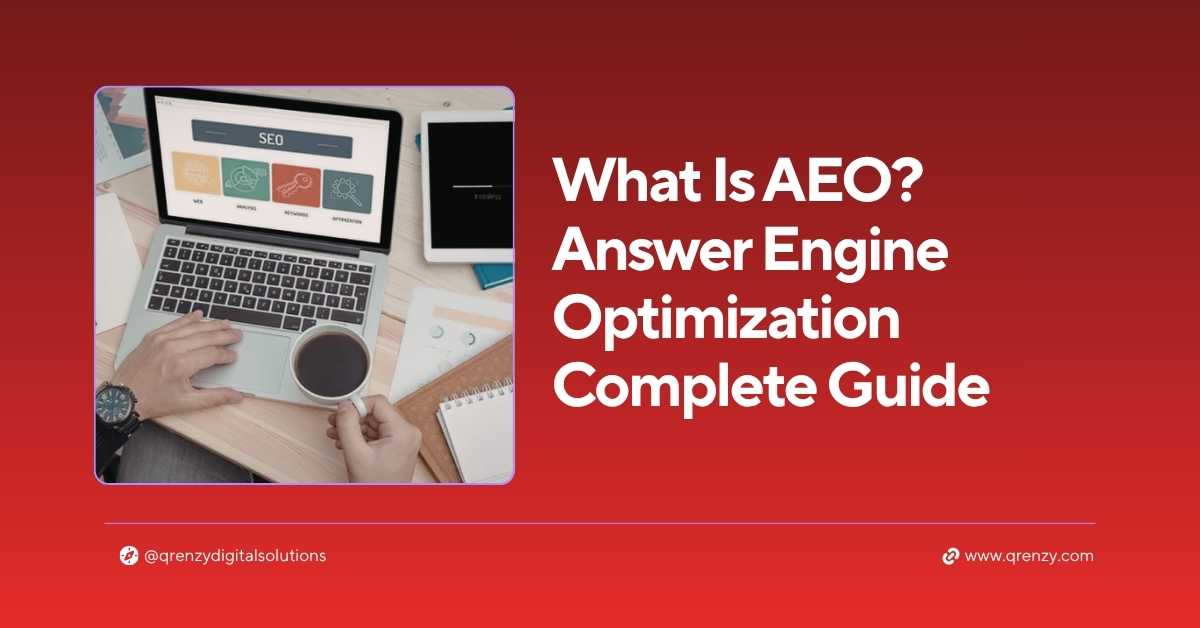
I run a digital marketing agency in Thrissur, Kerala. A few months ago, one of our clients called with a question that stopped me mid-sentence: “Sajeesh, I searched for our business on ChatGPT and it recommended our competitor. Why?”
That one question changed how we think about digital marketing.
Traditional SEO gets you ranked on Google. But your customers are increasingly not just using Google anymore. They are asking ChatGPT. Maybe querying Perplexity. They are using Google’s AI Overviews. And in all of those AI-generated answers, only one or two businesses get mentioned — the ones that have optimised for Answer Engine Optimization, or AEO.
If you have never heard of AEO, this guide explains exactly what it is, why it matters more than ever in 2026, and what you can do right now to make sure your business gets recommended by AI.
What Is AEO (Answer Engine Optimization)?
Answer Engine Optimization (AEO) is the practice of structuring and optimizing your content so that AI-powered search tools — including Google AI Overviews, ChatGPT, Perplexity, Gemini and Bing Copilot — can easily extract, understand and present your content as a direct answer to user queries.
Unlike traditional SEO, which focuses on ranking your website in a list of blue links, AEO focuses on becoming the answer itself — the content that an AI reads, summarises and presents to the user without them needing to click anywhere.
Think of it this way:
- Traditional SEO: Get to Page 1 of Google so users click your link
- AEO: Become the source AI platforms cite when they generate an answer
Both matter. But in 2026, AEO has become equally important — because over 60% of searches now end without a single click, and AI-generated answers are eating the visibility that used to belong to Page 1 rankings.
Why AEO Matters More Than Ever in 2026
The numbers tell the story clearly:
ChatGPT has 800 million weekly active users — people who ask questions and get direct answers, often without visiting any website.
Google AI Overviews now appear on at least 16% of all searches — significantly higher for comparison, how-to and high-intent queries. For searches like “best digital marketing agency in Kerala” or “how to rank on Google Maps,” AI Overviews often appear at the very top of results.
Perplexity AI processes hundreds of millions of queries monthly and is growing rapidly among research-oriented users who want sourced, structured answers.
Gartner predicts a 25% decline in traditional search volume by the end of 2026 as users shift to AI-powered answer engines for research and decision-making.
For businesses in India and the Gulf — where smartphone adoption is high and AI tool usage among younger demographics is growing fast — this shift is already happening. If your business is not visible in AI-generated answers, you are invisible to a growing segment of your potential customers.
AEO vs SEO — What’s the Difference?
Many business owners ask whether AEO replaces SEO. It does not. They are complementary strategies that work best together.
| Factor | Traditional SEO | AEO |
|---|---|---|
| Goal | Rank in Google blue links | Be cited in AI-generated answers |
| Success metric | Click-through rate, rankings | Citation frequency, brand mentions |
| Content format | Keyword-optimised long-form | Structured, question-answer format |
| Signals | Backlinks, technical SEO | Schema, E-E-A-T, structured data |
| Platforms | Google, Bing | ChatGPT, Perplexity, Google AI, Gemini |
| Traffic type | Click-based | Zero-click brand visibility |
The key insight is this: strong traditional SEO feeds AEO. AI platforms prefer to cite content that is already authoritative, well-structured and trusted by Google. You cannot skip SEO and jump to AEO — but if you are already doing SEO, adding AEO optimization is a relatively small additional effort with significant upside.
AEO vs GEO — Are They the Same?
You may also have come across the term GEO — Generative Engine Optimization. These terms are often used interchangeably, but there is a subtle difference worth understanding:
AEO (Answer Engine Optimization) focuses specifically on getting your content featured in direct answer formats — featured snippets, People Also Ask boxes, voice search results and AI Overviews. It is about answer-first content structure.
GEO (Generative Engine Optimization) is broader — it focuses on getting your brand cited, mentioned and recommended by AI platforms generally, including in conversational answers where no specific “featured snippet” format exists.
In practice, the tactics overlap significantly. A well-structured, authoritative, schema-marked-up website benefits both AEO and GEO simultaneously. Most practitioners in 2026 treat them as two dimensions of the same strategy.
How AI Answer Engines Decide What to Feature
Understanding how AI platforms select content to cite is the foundation of AEO strategy. Here is what is actually happening:
Step 1 — Query understanding: The AI breaks your question into sub-queries and searches for relevant content semantically — matching concepts, not just keywords.
Step 2 — Source retrieval: The AI retrieves the most relevant, authoritative documents. Factors include domain authority, content structure, recency and schema markup.
Step 3 — Quality scoring: Retrieved content is scored on relevance, authority, structural clarity and factual accuracy. Well-structured content with clear headings, direct answers and supporting data scores higher.
Step 4 — Answer generation: The AI synthesizes information from top-scoring sources into a cohesive answer — often citing the sources it drew from.
Step 5 — Attribution: The generated answer links back to the sources — this is the AEO win. If your content was a source, your brand gets the citation.
The critical insight: AI does not browse like a human. It does not care about your brand name or how long you have been in business. It cares about whether your content clearly answers the question, is structurally readable and comes from an authoritative source. That is what AEO optimizes for.
7 AEO Optimization Strategies That Work in 2026
1. Write Direct Definitional Openings
Every page and blog post should open with a clear, direct definition of its topic within the first 100 words. AI systems extract opening paragraphs heavily — they are looking for self-contained answers.
Bad opening: “In today’s digital world, businesses need to think about many different aspects of their online presence…”
Good AEO opening: “Answer Engine Optimization (AEO) is the practice of structuring content so that AI-powered platforms like ChatGPT, Google AI Overviews and Perplexity can extract and present it as a direct answer to user queries.”
The good version gives AI exactly what it needs in the first sentence. This is the single highest-impact AEO change most websites can make immediately.
2. Use Question-Based H2 and H3 Headings
Structure your content around the actual questions your audience asks. Not keyword headings — question headings.
Instead of: ## SEO Services Use: ## What Does an SEO Service Include?
Instead of: ## Benefits of Social Media Marketing Use: ## Why Does Social Media Marketing Matter for Small Businesses?
Question-format headings tell AI systems exactly what each section answers — making your content far more extractable for featured snippets and AI Overviews.
3. Implement FAQ Schema on Every Page
FAQ schema (structured data markup) tells Google and AI platforms that your content contains question-and-answer pairs. Pages with FAQ schema are significantly more likely to appear in featured snippets and AI Overviews.
Every service page, blog post and location page on your website should have an FAQ section with at least 4–5 questions, and FAQ schema implemented in JSON-LD format.
At Qrenzy, we implement FAQ schema as standard on all client websites — it is one of the fastest ways to improve AEO visibility.
→ Learn more about how we implement Search Engine Optimization with full schema markup
4. Build Topical Authority Through Content Clusters
AI platforms prefer to cite websites that have demonstrated deep expertise in a topic — not just one good article, but a cluster of related, interlinked content that signals comprehensive knowledge.
For a digital marketing agency like Qrenzy, our content cluster includes:
- What is digital marketing
- What is SEO
- What is AEO (this post)
- What is GEO
- How to rank on Google Maps
- Local SEO for Kerala businesses
- How to get found on ChatGPT
Each post links to related posts and service pages, building a web of topical authority that AI platforms recognize as genuine expertise.
5. Add Statistics and Specific Data Points
AI systems favor content with specific, verifiable data over vague generalizations. Including statistics, percentages, timeframes and measurable outcomes makes your content more “citation-worthy.”
Weak: “SEO takes some time to show results.” Strong: “Most businesses see measurable keyword ranking improvements within 60–90 days of consistent SEO implementation, with significant organic traffic growth typically occurring between months 3–6.”
The second version gives AI a specific, extractable data point. The first gives it nothing to cite.
6. Maintain NAP and Entity Consistency
AI platforms cross-reference your business information across multiple sources — your website, Google Business Profile, social media, directories and third-party review platforms. Inconsistent information (different phone numbers, addresses or business names across platforms) reduces your trustworthiness in AI systems.
Ensure your business name, address, phone number and website URL are identical across every platform where your business appears. This is particularly important for local businesses in Kerala, Thrissur and Gulf markets where we manage multi-platform presence for clients.
7. Earn Third-Party Mentions and Citations
AI systems like ChatGPT heavily weight third-party mentions. Referenced in industry publications, review platforms, directories and authoritative websites. This is why we always tell clients: your AEO strength is only partly determined by your website. The rest is your broader digital footprint.
For businesses in India and the Gulf, this means:
- Getting listed on Clutch, G2 and industry directories
- Earning Google reviews consistently
- Being mentioned in local news, industry blogs and business directories
- Active participation in relevant online communities
Real AEO Results — What We’ve Achieved for Clients
AEO is not theoretical for us at Qrenzy — we practice what we preach and track the results.
Al Fanar Group (Oman): After implementing comprehensive schema markup, FAQ sections, speakable schema and structured content on their website, Al Fanar now appears in AI-generated answers on ChatGPT and Google AI Overviews for key product searches in Oman. This brand visibility in AI answers — reaching users who never click any website — was not measurable six months ago. It is now a standard part of our reporting.
Qrenzy itself: Our own website (qrenzy.com) scored 92/100 on SEOmator’s GEO/AEO audit — placing us in the top tier for AI search readiness among digital agencies in India. The site now has 12 schema types implemented, Speakable schema on voice-search content, Author Person schema on all blog posts and a comprehensive llms.txt file guiding AI crawlers.
→ See how we implement AI Marketing Automation alongside AEO for maximum AI visibility
How to Measure Your AEO Performance
Traditional SEO is measured through rankings and traffic. AEO requires different metrics:
Citation tracking: Manually search for your target keywords and business category in ChatGPT, Perplexity and Google AI Overviews. Is your brand mentioned? How often? This is your baseline.
AI referral traffic: In Google Analytics 4, check your referral traffic sources. ChatGPT.com, Perplexity.ai and similar domains appearing as referrers indicate AI-driven traffic — users who saw your brand cited in an AI answer and then visited your site.
Branded search volume: As AI mentions increase, branded searches (people searching your business name directly) typically increase. This is a proxy metric for growing AI visibility.
Featured snippet presence: Track how many of your target keywords trigger featured snippets where your content appears. Google Search Console shows impression data.
Share of voice in AI: Run the same queries across platforms monthly and note whether your brand citation frequency is increasing or decreasing relative to competitors.
AEO for Kerala and Gulf Businesses — Why It Matters Locally
You might wonder whether AEO is relevant for a local business in Thrissur, Kochi, Muscat or Dubai. The answer is absolutely yes — and here is why.
When a potential customer in Kerala searches “best digital marketing agency in Thrissur” on ChatGPT or asks Google AI “which agency does SEO for small businesses in Kerala,” the answer they get is determined by AEO. The agency that appears in that answer gets the enquiry. The agency that does not appear gets nothing — even if they rank on Page 1 of Google.
For Gulf-based businesses, this is equally powerful. Expatriate consumers in Oman and UAE heavily use AI tools for research and discovery. A business that appears in AI answers for “interior design companies in Muscat” or “Grohe dealers in Oman” captures demand from an increasingly AI-first audience.
Local AEO requires everything we have covered above, plus specific local entity signals: accurate Google Business Profile, consistent local citations, local reviews and locally-relevant content. Our Local SEO service includes AEO elements as standard — because local and AI visibility are now inseparable.
Getting Started with AEO — Your First 5 Steps
If you are starting AEO from scratch, here is a prioritised action plan:
Week 1: Audit your existing content. Do your service pages and blog posts open with clear definitional statements? Do they have FAQ sections? Identify the gaps.
Week 2: Add FAQ sections with 4–5 questions to your top 5 most important pages. Implement FAQ schema using JSON-LD (or ask your developer to do it).
Week 3: Restructure headings on key pages from keyword headings to question headings. Rewrite opening paragraphs to lead with clear, direct definitions.
Week 4: Run your website through a GEO/AEO audit tool (SEOmator offers one) to identify specific schema gaps and content citability scores.
Month 2 onwards: Build topical authority through consistent content publishing, earn third-party citations and monitor your AI visibility monthly.
If this sounds like significant work — it is. But the businesses that build AEO authority now, while most competitors are not even aware of it, will have a compounding advantage that is very difficult to overcome later.
→ Need help implementing AEO for your business? Get a free SEO audit — we assess your current AEO readiness as part of every audit.
Frequently Asked Questions About AEO
SEO optimizes your website to rank in traditional search engine results (Google blue links). AEO optimizes your content to be featured as a direct answer in AI-generated responses from platforms like ChatGPT, Perplexity and Google AI Overviews. Both are important — AEO builds on a strong SEO foundation rather than replacing it.
Initial AEO improvements — such as appearing in featured snippets and Google AI Overviews — can happen within 4–8 weeks of implementing schema markup and restructuring key content. Building consistent AI citation across ChatGPT and Perplexity typically takes 3–6 months of sustained effort, as these platforms update their training data and retrieval systems on their own schedules.
Yes — local AEO is one of the most impactful opportunities for small and medium businesses in Kerala and Gulf markets. When potential customers ask AI tools “best [service] in [city],” the businesses that appear are those with strong local entity signals, structured content and consistent third-party presence. Local AEO is a core part of our service for India and Gulf market clients.
AEO and GEO (Generative Engine Optimization) are related but not identical. AEO specifically focuses on answer formats — featured snippets, voice search, AI Overviews. GEO is broader, focusing on brand citation and recommendation across all AI platforms. In practice, the optimization tactics overlap significantly and most practitioners implement both simultaneously.
FAQPage schema is the most directly impactful for AEO — it signals structured question-and-answer content to both Google and AI platforms. Other important schema types include Article (with Author), HowTo, Speakable and Organization. Implementing all of these is what pushed Qrenzy’s own GEO/AEO score to 92/100.
Basic AEO — adding FAQ sections, restructuring headings, writing direct definitional openings — can be done yourself with guidance. Technical implementation of schema markup, Speakable schema, Author Person schema and entity optimization is more complex and typically requires developer or agency expertise. The strategic content changes are accessible; the technical implementation benefits from professional support.
Conclusion
Answer Engine Optimization is not a future trend — it is happening right now. The 60%+ of searches that end without a click, the 800 million weekly ChatGPT users, the Google AI Overviews appearing on every high-intent search — this is the reality of search in 2026.
Businesses that implement AEO now — while most competitors in Kerala and the Gulf are still focused only on traditional SEO — are building a first-mover advantage in AI search visibility that will compound for years.
The good news is that the fundamentals of AEO — clear content structure, direct answers, schema markup, topical authority, consistent entity presence — are not radically different from what good SEO has always required. You are adapting a strategy you may already have, not starting from scratch.
If you want to know where your business currently stands on AEO and GEO readiness, start with a free audit. We assess AI search visibility as part of every SEO audit we run.
Questions about AEO for your specific business in Kerala, Oman or the UAE? WhatsApp us directly — we reply within a few hours.
Leave a Comment